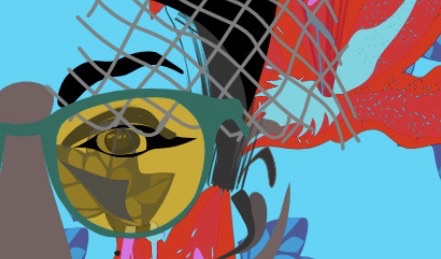
I have often wondered why I find it so difficult to make less. Why every project begins as a simple idea but soon attracts another idea, another symbol, another colour, another story. For years I mistook this for a lack of discipline. Now I see it differently.
I’m a maximalist by nature.
Not because I enjoy excess for its own sake, but because I experience the world as layers.
I don’t see a flower. I see geometry hidden inside its petals. I don’t see a pattern. I see history repeating itself across generations. I don’t see colour as decoration. I see emotion, memory and culture woven together.
As an artist and designer, I have always searched for the invisible architecture beneath ordinary things.
Pattern.
Rhythm.
Connection.
Everything speaks if you pay attention long enough.
My work is less about creating images than uncovering relationships. Nature converses with architecture. African heritage meets Art Deco elegance. Surface pattern becomes storytelling. Illustration becomes memory. Design becomes emotion.
Many artists simplify the world.
I seem destined to gather it.
Perhaps this comes from the way my mind works. One thought naturally leads to another, and another after that, until what began as a simple sketch becomes an ecosystem of ideas. Rather than fighting this instinct, I have begun to understand it.
Maximalism, for me, is not visual noise.
It is organised abundance.
It is creating enough detail that someone discovers something new each time they look.
I want viewers to pause.
To notice.
To return.
To find meaning that wasn’t visible the first time.
This is why symbolism matters so much to me. A triangle can speak of family. A circle can suggest continuity. A leaf can become resilience. A repeated motif becomes memory. Layers transform decoration into narrative.
As a designer, I care deeply about beauty.
As an artist, I care even more about meaning.
The two should never compete.
They should dance.
I admire movements like Art Nouveau and Art Deco because they understood that design could be both functional and poetic. They believed everyday objects deserved beauty. That belief has become part of my own practice.
Whether I create a print, a textile, wallpaper or illustration, I am really asking the same question.
How can art make ordinary life feel richer?
I don’t want my work to exist only inside galleries.
I want it to live in homes, on fabric, across walls, inside books, wrapped around everyday rituals.
Art should accompany life.
Not interrupt it.
There was a time when I searched for a single style, believing consistency meant repetition. I no longer think that is true.
My consistency is not found in identical images.
It is found in recurring ideas.
Nature.
Pattern.
Memory.
Culture.
Emotion.
Hope.
They appear again and again, wearing different clothes.
I’ve realised that I am less interested in making collections than building a visual language. Every piece becomes another sentence in a conversation that may last a lifetime.
Perhaps that is what maximalism truly means.
Not filling every available space.
But allowing every idea to find its place.
I am a maximalist because I believe the world is richer than it first appears.
Because stories deserve layers.
Because beauty deserves depth.
Because patterns reveal who we are.
And because every artwork is another opportunity to remind someone that even the smallest detail belongs to something much larger.
That is the work I want to spend my life making.

 VERDANT AFRO ART
Leave a comment